
Local SEO for Service Businesses (The Plain English Version)
Local SEO sounds technical, but most of it is common sense. Five things you can sort yourself so people in your area find you when they search on Google.

Jamie Clarke
21 May 2026 · 4 min read
SEO.
Three letters that make most business owners glaze over.
I get it, it sounds technical, it sounds expensive, and half the people who talk about it make it sound like you need a degree in computer science to do it properly.
You don’t.
If you’re a service business that works in a set area, local SEO is a lot simpler than it sounds, and most of it you can sort yourself.
(I’ll be straight with you, SEO isn’t something I sell. This is just the stuff I’d tell a mate.)
What is local SEO, in plain English?
It’s making sure that when someone in your area searches for what you do, they find you.
That’s it.
When someone types “physio in Bolton” or “physio near me” into Google, the businesses they see at the top and on the map are decided by local SEO.
Your job is to be one of them.
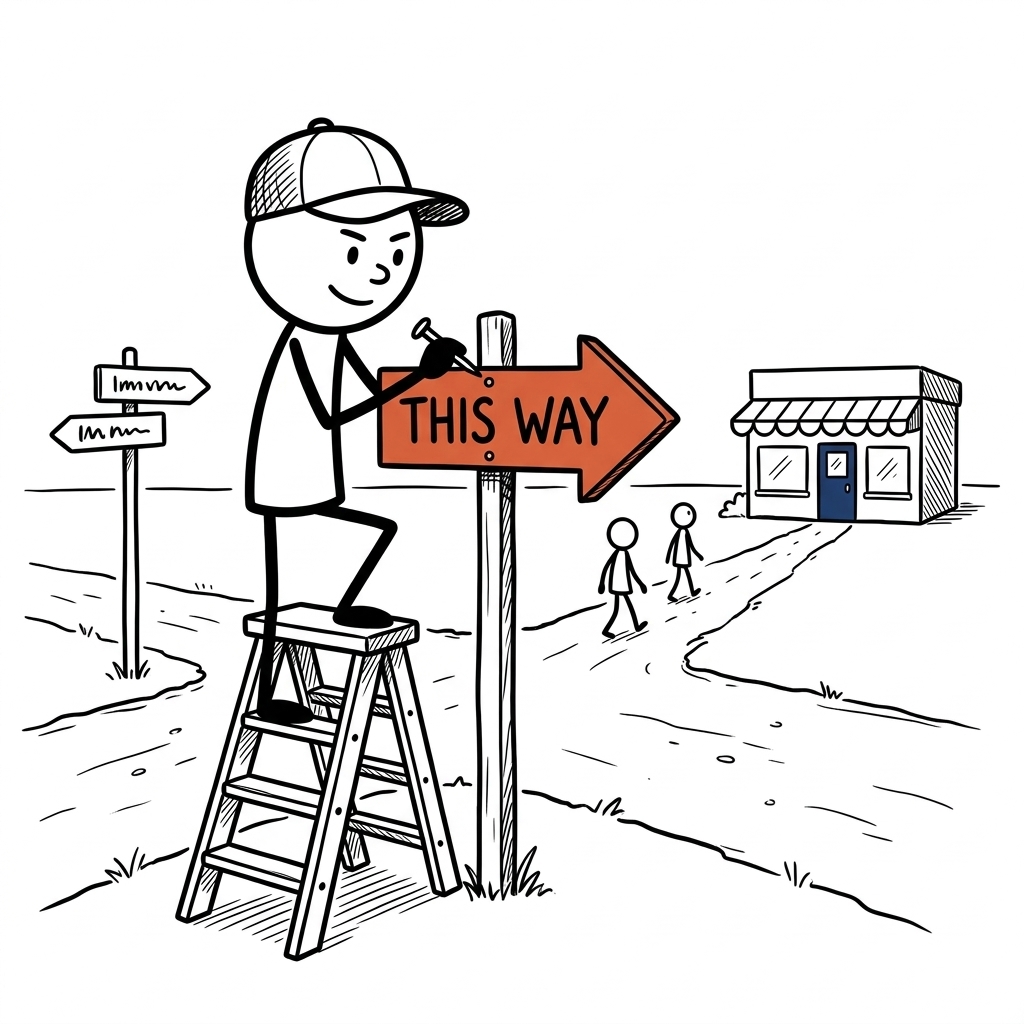
Think of it like putting up signposts.
The more clear signs pointing at you, the more people find their way to your door.
The five things that actually matter
I’m going to skip the technical stuff and stick to what makes the biggest difference.
1. Your Google Business Profile
This is the big one.
If it isn’t set up properly, none of the rest matters much.
I’ve written about why it matters so much, and there’s a 30-minute tune-up you can work through today.
2. Your website needs to say where you are
Sounds obvious.
But I’ve seen loads of service business websites that never mention where they actually work, not on the homepage, not in the page titles, nowhere.
Google can’t read your mind.
If your website never mentions Bolton, how is Google supposed to know you work in Bolton?
Put your town on your homepage, in your page titles (the bit that shows as the blue link in Google), on your service pages and in your footer.
“Sports massage and physio in Bolton and the surrounding area.”
Not hidden, not buried, right there.
3. Get listed in the right directories
Yell, Thomson Local, your local council’s business directory, your trade or professional body’s directory, anywhere your business can sensibly be listed.
The word that matters is CONSISTENT.
Your business name, address and phone number need to be exactly the same everywhere.
If your website says “12 High Street” and Yell says “12 High St”, that’s two slightly different answers to the same question, and you’re making Google’s job harder than it needs to be.
Tidy it up.
4. Write about local stuff
A blog post on “5 signs your back pain needs a physio” is useful.
The same post with a line about the clinic in Bolton, and the people you see from Farnworth and Horwich, is useful AND tells Google exactly where you work.
Mention local places naturally.
Not stuffed in awkwardly, just the way you’d say it out loud.
5. Get reviews that mention what you did and where
“Great service” is nice.
“Sorted my shoulder out after months of pain, best physio in Bolton” is a lot more useful, to the next person reading it and to Google.
Google says it straight in its own help pages: “More reviews and positive ratings can help your business’s local ranking” (Google).
You can’t control what people write.
But you can nudge them: “If you’ve got a minute to leave a Google review, it’d really help, and it’s even better if you mention what we worked on.”
What you don’t need to worry about
You don’t need to understand meta tags and schema markup (the behind-the-scenes code stuff) to get started.
You don’t need to obsess over keywords.
And you don’t need to sign up to a monthly SEO contract before you’ve done the basics yourself.
Most local businesses haven’t done all five of these, so doing them properly, and keeping at it, puts you ahead of plenty of the people you’re up against.
Your job today
Google yourself.
Search for what you do plus your town, the way a customer would.
Are you on the first page? Are you on the map?
If not, start with your Google Business Profile, then make sure your homepage says where you work.
It won’t change overnight, but them two alone are the best place to start.
Google’s own advice is to wait a few weeks before you judge whether a change has worked, and some take several months (Google).
Want to see where you stand?
Your website, Google profile, reviews and socials are all part of Your Web Review. You get a video of me going through it all and the three things I’d fix first.
No big sales pitch.
And if you’d like one short email every Sunday on making your marketing easier, get the Marketing Memo. It’s free.
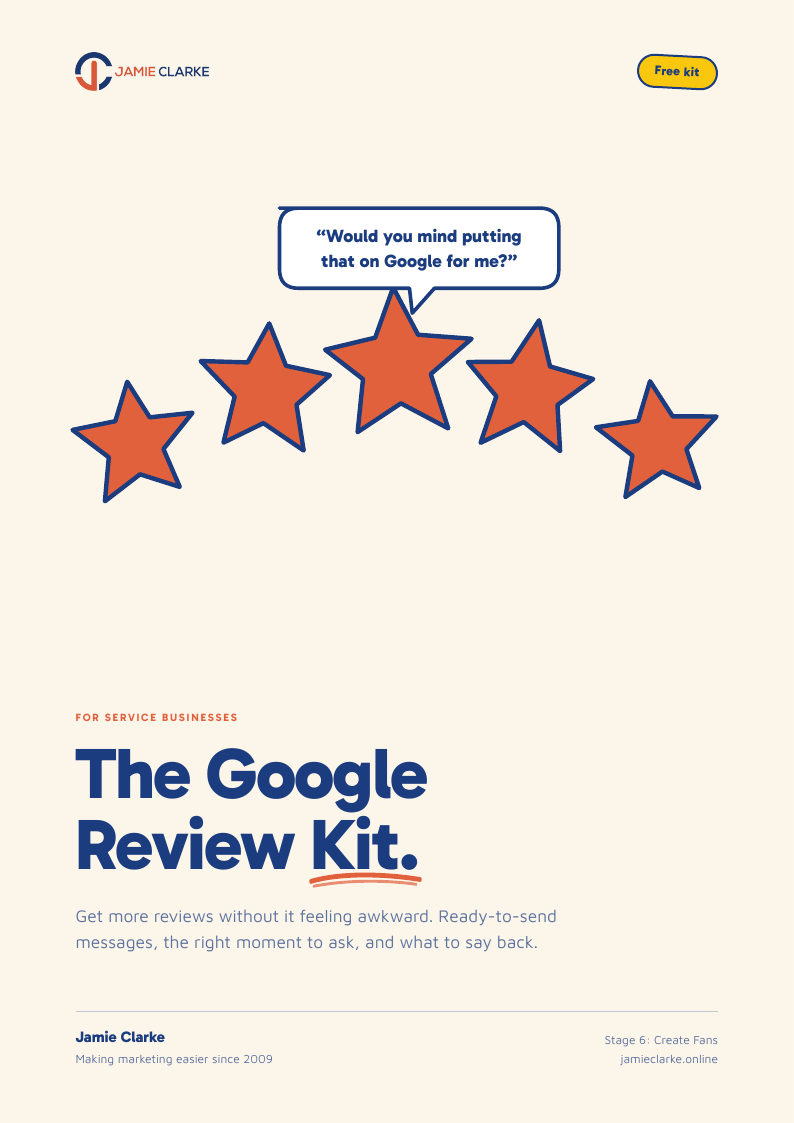
Free Kit · 9 pages
The Google Review Kit
Get more Google reviews by asking at the right moment, with the right link.
By signing up you agree to receive marketing emails. Unsubscribe anytime. Privacy policy.
It's on its way! Check your inbox in the next few minutes.
Something went wrong. Please try again.
Want me to look at yours?
I'm Jamie. I help coaches and small business owners turn their website and marketing into a steady stream of enquiries. Grab a free web review and I'll show you your quickest wins, no big sales pitch.